 Войти
ВойтиAl Jazeera continues broadcasting in Iran as regime employs 'absolute digital isolation' - report

'The Jerusalem Post' was unable to verify additional foreign media outlets where reporters have successfully broadcast from within Iranian territory.






The first article of the law states: “Every worker has the right, in payment for services rendered, to a minimum wage capable of satisfying, in a given region of the country and at a given time, their normal needs for food, housing, clothing, hygiene, and transportation.”
“Until then, the contract was civil law-based, for the provision of services. There was no minimum wage that the employer was required to pay,” he says.

Then-President Getúlio Vargas also faced pressure from economic elites, researchers have found, even as more money was injected into the economy. According to Professor Deusdedith Rocha of the University Center of Brasília (Ceub), Brazil’s elite adopted an ambivalent stance toward the introduction of the minimum wage.
“They both resisted and strategically adjusted to the changes of the time. Distrust in the agricultural sector was offset by the idea of social stabilization,” he explains.
Rocha adds that the minimum wage became a fundamental achievement in the regulation of labor relations.
“The worker perceived the minimum wage as fundamental to having a greater possibility of survival,” he stated.
Trade unions celebrate the Minimum Wage Law but argue that real wage adjustments should become a state policy, not just a government policy.
“The minimum wage is fundamental because it sets a benchmark both for categories without a minimum wage and for retirees and pensioners. It ultimately becomes an important instrument for income distribution in our country,” says João Carlos Gonçalves, general secretary of Força Sindical (Union Force).
He recalls that trade unions fought for the minimum wage adjustment to become an instrument for income distribution. “The adjustment was achieved in Congress and, as a result, the minimum wage saw a real increase, which was cut during the [Michel] Temer and [Jair] Bolsonaro governments.”
According to Gonçalves, the policy of real increases was reinstated during President Luiz Inácio Lula da Silva’s government. “Now there has been a return to a real benchmark, slightly lower, which is still important, even if smaller,” he says.
For Ariovaldo de Camargo, of the Central Única dos Trabalhadores - CUT (Unified Workers’ Central), the minimum wage “for active workers is a cushion, an important reference point, but falls short of what is needed.”
Camargo argues that a “more rapid” recovery policy is necessary.
“After the 2016 coup [that removed Dilma Rousseff from power], when we went six years without adjustments above inflation - and at times even below - it was, we can say, a discontinuous policy,” according to Camargo.
Ronaldo Leite, president of the Central dos Trabalhadores e Trabalhadoras do Brasil - CTB (Central of Workers of Brazil), also emphasizes the importance of the minimum wage. “It is a fundamental guarantee for workers. Having a constitutional floor minimally ensures the purchasing power of the working class.”
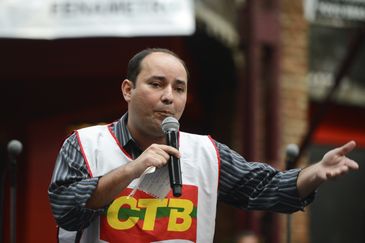
Leite notes that the Lula government reinstated the policy of increasing the minimum wage, allowing for adjustments above inflation, but acknowledges that its value has been eroded over the years.
“The minimum wage has lost much of its purchasing power compared to when it was first established. Dieese [the Inter-Union Department of Statistics and Socioeconomic Studies] calculates that the ideal value today would be BRL 7,106.83. The CTB advocates maintaining and expanding the policy of minimum wage increases to ensure that the working class experiences an improvement in living conditions,” Leite adds.
The minimum wage in effect this year is BRL 1,621.00.
Dieese is supported by the labor movement. It conducts research on the cost of living, employment and unemployment, and issues related to the world of work and workers.


